
Moving beyond taboo
Menstrual Blood in Art

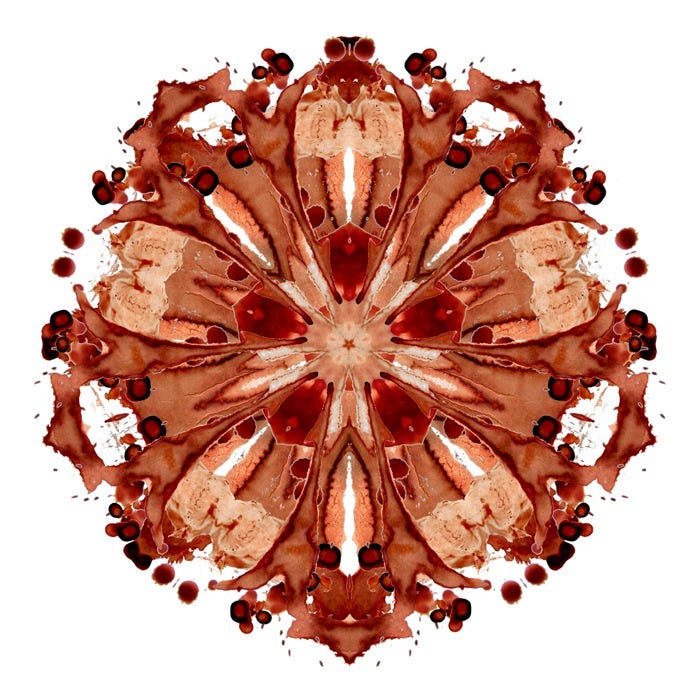
You might wonder, "How does one come to research menstrual blood and its presence in contemporary art?" The short answer is that this project developed out of reflections on an experience of menstruation, extended over four weeks, that culminated in an ectopic pregnancy and subsequent removal of my right fallopian tube. This was my second pregnancy, following a successful first and, later, two more healthy children. Coupled with a timely reading of Foucault's "Of Other Spaces," allowed this project to be grounded in the subjective—I became a deeply embodied author seeking my phenomenological voice in this field.
As promised in my welcome post, this edition marks our first deep exploration into 'The Leaky Body in Art'—the first of three core research threads. In this series, we'll examine how artists transform bodily fluids from the abject into the sacred, beginning today with menstrual blood's journey from taboo to artistic medium.
Note: This post features artworks addressing bodily experiences and trauma, which may be intense but are central to our feminist exploration.
My research began with a seemingly simple question:
Is menstruation and, more specifically, menstrual blood, visualised in contemporary art and, if so, how is it interpreted or made meaningful?
☽ Tracing the Invisible
Indeed, references to menstruation are found throughout popular culture industries—advertising, television, music, and film. Initial inquiries revealed that 1970s feminist artists presented some strong voices advocating for visibility and discussion of women's issues, with menstruation and women's bodies being important topics in this type of politics.


Beyond the 1970s, other artists have continued to challenge dominant narratives in art history. While isolated cases of reverence for menstruation exist across cultures, these remain exceptions. More commonly, societies impose strict rules about the visualisation of menstrual blood in art and visual culture.
These hegemonic codes controlling the discussion, commemoration, or visualisation of menstruation have been formed over long periods by traditional communities, orthodox religious authorities, and the patriarchal medical gaze. The resulting taboos and constraints have been so pervasive that they've been internalised by millions of women worldwide, transforming a natural bodily process into something perceived as negative and shameful.
❦ Cultivating New Ground
Whilst academia offered a surfeit of material—from cultural constructions to anthropological examinations—there had been no definitive academic study carried out on the topic of menstruation in contemporary art, let alone in the discipline of art history, until my thesis in 2014. Eleven years on, I have published several articles and contributed "Painting Blood: Visualising Menstrual Blood in Art" to The Palgrave Handbook of Critical Menstruation Studies (2020). I’m grateful to scholars like Bee Hughes and Camilla Mørk Røstvik, whose work on menstrual art and culture complements my own.
My aim for this newsletter is to bring this content into a broader conversation. This topic may challenge some, but it’s time we honour women’s blood for its power and potential instead of being shrouded in the taboo and humiliation we have internalised for too long.
Encouragingly, some literature intersects film and menstruation, most notably Barbara Creed's "The Monstrous Feminine," which not only provided my research with the endorsement that this topic was worth pursuing but also offered influential narratives and accounts of the 'menstrual monster' and textual deconstructions of Freud. Films like Carrie (1976, remade in 2013) shape cultural views of menstruation, influencing artists who confront similar ‘monstrous’ stereotypes.


⚕ Embodied Knowledge
Throughout this newsletter, I will showcase contemporary works by professional artists that utilise menstruation or the semiotics of menstrual blood to express ideas of gendered space, taboo, abjection, lived experience, and social-cultural inequality. This publication seeks not only to document these artworks but to prompt a wider conversation about why certain bodily experiences have been deemed unworthy of serious artistic and scholarly attention.
The notion of ‘gendered blood’ is a concept that struggles against patriarchal traditions, which denigrate and suppress images of menstruation, while traditionally in European and American art, women's bodies are valorised as vehicles for male scopic desire. Biologically, blood may not be gendered, but it is transformed by society's values—female blood becomes dirty discharge, abject, shameful. In Jewish, Christian, and Islamic traditions, it becomes associated with immorality or accursedness due to Eve's temptation of Adam.
Unlike Christ's sanctified blood in the Eucharist or the blood of heroes lost on the battlefield, menstrual blood is cast as shameful in many traditions. Earlier art used blood in controlled ways to show concepts of humanity, sacrifice, and transcendent spiritual values, almost always in depictions of Christ's blood.
Gendered blood in contemporary art challenges these traditions. It has become a contested image and medium appropriated from traditional masculinity for different subject positions and identities previously excluded from art history. By reclaiming and revaluing feminine blood, contemporary artists disrupt these long-established hierarchies of representation, creating visibility for experiences that patriarchal aesthetic traditions have systematically erased.
◈ Blood Hierarchies in Art
Artworks that engage with menstruation across cultures are important because they work against stereotypes by actively re-valuing gendered blood—showing it in a positive, defiant, or ambiguous light. This stands in marked contrast to historical traditions of blood representation in Western art, where male bloodshed was often glorified through religious and heroic imagery.
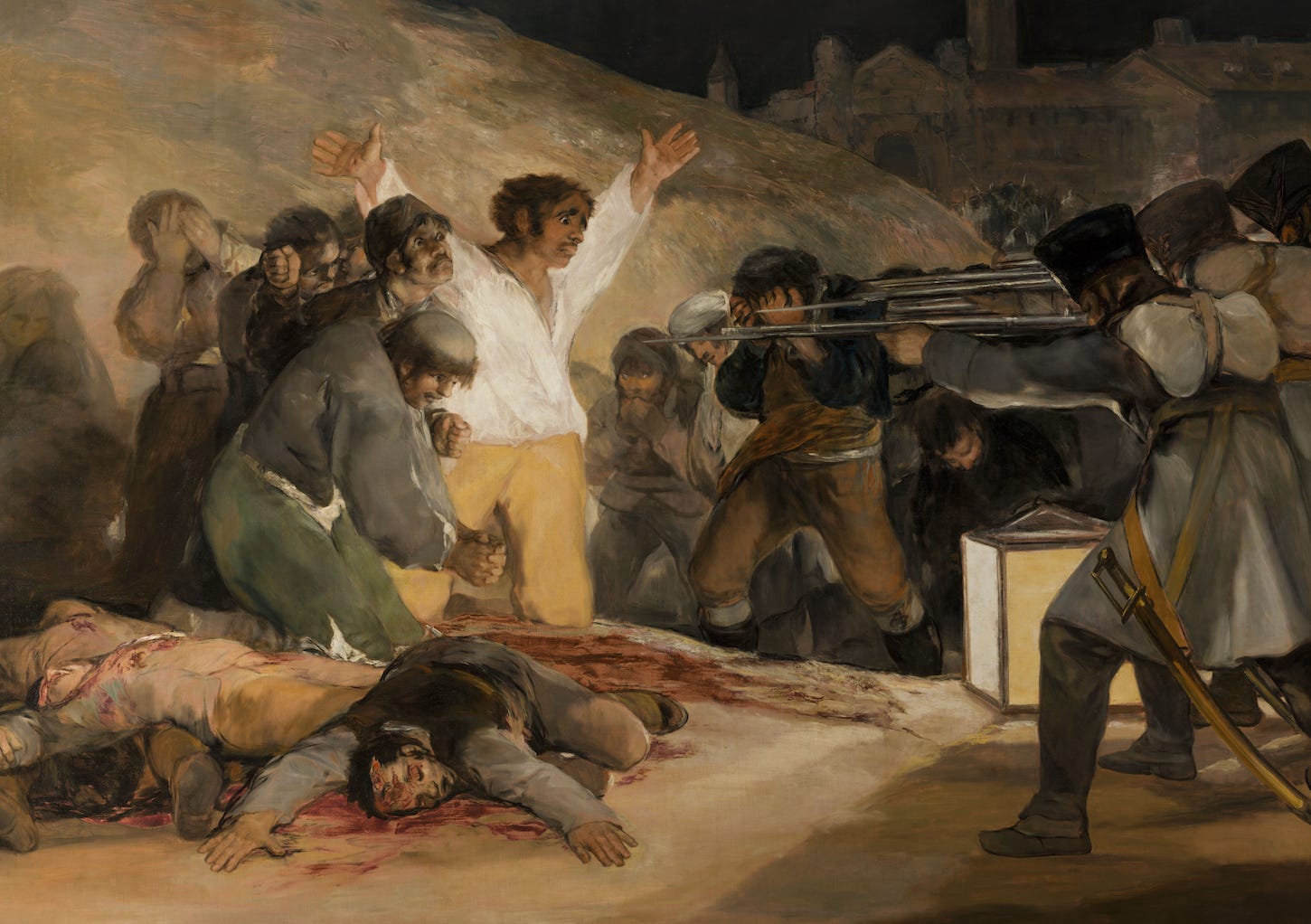
Historical art often sanctified male blood, as seen in Francisco Goya's The Third of May 1808 in Madrid (1814). In this painting, blood spilled in conflict is valorised as heroic, with the central figure's Christ-like pose elevating male sacrifice through religious symbolism. This reflects Foucault's concept of a "society of blood," where power is expressed through controlled bloodshed (History of Sexuality 1, 147). Menstrual blood, by contrast, has historically been dismissed as waste or taboo, underscoring a stark gendered divide in art's treatment of blood.
Patriarchal values kept menstruation as a subject far from the mainstream of art and art history until feminism in the 1970s. Contemporary works I'll discuss in future posts challenge what is acceptable and question what should and should not be visible. Many menstrual works are meant to shock, in true avant-garde fashion, but not needlessly or nihilistically. They are important interrogations of aesthetic authority and decorum, challenging ignorant beliefs about art's functions, as much as they create visibility and space within art and the public domain for contested values associated with blood. These values may not be easy to look at or conventionally palatable, but at least they do not blindly follow the requirement that art can only be about traditional prettiness and chaste femininity.
My theoretical framework draws on Michel Foucault's notion of heterotopias—imaginary spaces existing in reality as sites of otherness—to place menstruation in a liminal realm that artists exploit to disrupt patriarchal norms. Judith Butler's concept of performativity, where gender forms through repeated bodily acts, reveals how these artworks reshape identity.
Maurice Merleau-Ponty's phenomenology grounds these works' power in lived, embodied experience. Together, these lenses show how menstrual blood in art challenges the valorised male, sealed body against the leaky, female body's raw materiality.
To read menstruation as 'gendered blood' is to see how artists expose the ritualisation of difference, through cleansing practices or psychoanalytic taboos—that positions women as leaky, challenging the male, sealed body ideal.
✧ Blood Traces: Radical Feminine Embodiment
To illustrate how artists have challenged the invisibility of women’s bodily experiences, let us examine two iconic works, united in their bold portrayal of female embodiment.
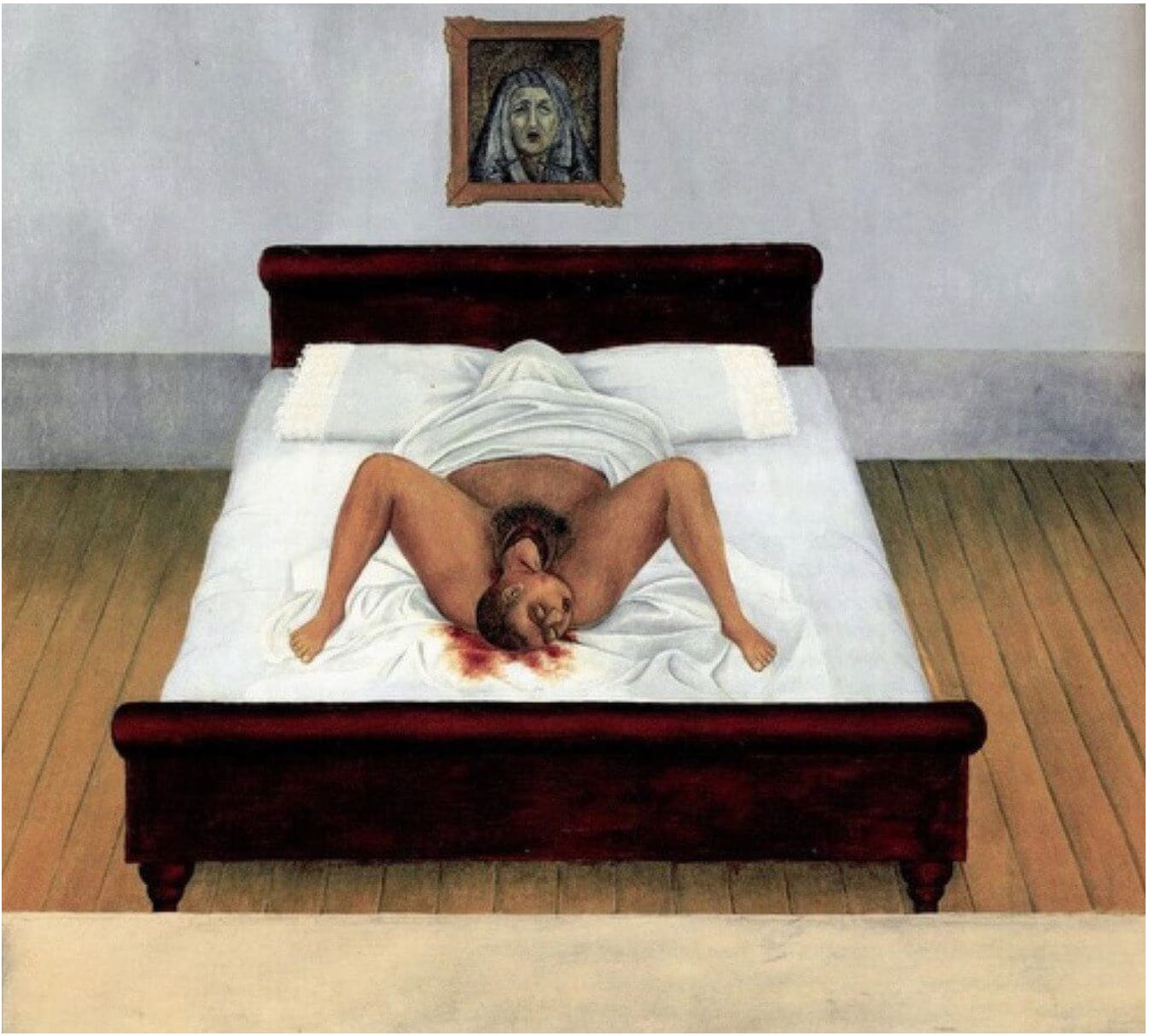
Frida Kahlo’s My Birth (1932) confronts us with a visceral depiction of childbirth rarely seen in Western art history. The painting portrays Kahlo’s own body on a bed, legs spread, in a surreal act of self-birth, blood pooling on white sheets that evoke traditional birthing practices. Above hangs an image of the Mater Dolorosa (Our Lady of Sorrows), weaving Catholic iconography into the raw physicality of female experience. Kahlo’s deliberate, unsentimental brushwork—deep crimson blood against stark white—collapses distinctions between birth, self-creation, and artistic genesis, reclaiming female bodily power from patriarchal silence.
Decades later, Tracey Emin's installation, My Bed (1998) presents another meditation on embodied female experience through different visual strategies. The unmade bed with its stained sheets, discarded underwear (some visibly marked with menstrual blood), empty vodka bottles, and contraceptive packaging documents a period of emotional turmoil following a relationship breakdown. Without directly representing the body, Emin nonetheless makes the female body powerfully present through its traces and excretions.
Where Kahlo's work confronts through direct representation, Emin's operates through metonymy—the stained sheets stand in for the body itself. Both artists refuse to sanitise female bodily experience. The menstrual stains in Emin's work function not as symbols but as material evidence of lived experience, challenging the viewer to confront what society has deemed unseemly or improper.
Contemporary artists continue this tradition, such as Zanele Muholi, whose Isilumo siyaluma series (2011) uses menstrual blood stains to address trauma and healing, further challenging cultural taboos around women’s blood.
These works bookend much of the artistic exploration we'll examine in future posts. From Kahlo's painterly confrontation to Emin's conceptual installation, artists have developed diverse visual strategies to challenge the invisibility of women's embodied experiences. What unites them is their refusal to acquiesce to cultural expectations of silence around women's blood—whether reproductive or menstrual—and their insistence that these experiences belong in our cultural discourse and visual field.
In forthcoming editions, we will delve deeper into specific artworks that continue this tradition of making visible what has been systematically obscured, examining their historical contexts, material approaches, and cultural impacts with the attention they deserve.
Through Embodied Visions, we will journey together through this rich landscape of art, ritual, and sacred traditions—reclaiming spaces for women’s embodied wisdom that have too long remained in shadow.
⌘ Reading List
Want to dive deeper? Here’s a reading list of thinkers shaping this work:
Bakhtin, Mikhail. 1984. Rabelais and His World. Translated by Hélène Iswolsky. Bloomington: Indiana University Press.
Bobel, Chris, Inga T. Winkler, Breanne Fahs, Katie Ann Hasson, Elizabeth Arveda Kissling, and Tomi-Ann Roberts, eds. 2020. The Palgrave Handbook of Critical Menstruation Studies. Singapore: Palgrave Macmillan. https://doi.org/10.1007/978-981-15-0614-7.
Green-Cole, Ruth. 2020. “Painting Blood: Visualizing Menstrual Blood in Art.” In The Palgrave Handbook of Critical Menstruation Studies, edited by Chris Bobel, Inga T. Winkler, Breanne Fahs, Katie Ann Hasson, Elizabeth Arveda Kissling, and Tomi-Ann Roberts, [page range]. Singapore: Palgrave Macmillan. https://link.springer.com/chapter/10.1007/978-981-15-0614-7_57
Butler, Judith. 1990. Gender Trouble: Feminism and the Subversion of Identity. New York: Routledge.
Creed, Barbara. 1993. The Monstrous-Feminine: Film, Feminism, Psychoanalysis. London: Routledge.
Foucault, Michel. 1986. “Of Other Spaces.” Translated by Jay Miskowiec. Diacritics 16 (1): 22–27.
Foucault, Michel. 2008. History of Sexuality, Volume 1: The Will to Knowledge. Translated by Robert Hurley. Camberwell, Victoria: Penguin Books.
Grosz, Elizabeth. 1994. Volatile Bodies: Toward a Corporeal Feminism. Bloomington: Indiana University Press.
Irigaray, Luce. 1985. This Sex Which Is Not One. Translated by Catherine Porter with Carolyn Burke. Ithaca, NY: Cornell University Press.
Lupton, Mary Jane. 1993. Menstruation and Psychoanalysis. Urbana: University of Illinois Press.
Merleau-Ponty, Maurice. 2012. Phenomenology of Perception. Translated by Donald A. Landes. London: Routledge.
Young, Iris Marion. 2005. On Female Body Experience: “Throwing Like a Girl” and Other Essays. Oxford: Oxford University Press.
⚝ Next Week’s Tease
As we continue this journey, I’m developing a new way to read these works. In our next edition, we’ll begin unpacking a new lens for reading these embodied visions—what I’m calling ‘Femiotics’, a framework that captures the unique signs of the female body in art. Join me as we explore how menstruation becomes a powerful language of resistance and revelation.
Embodied Visions explores women’s bodily wisdom, sacred traditions, and art history—from ancient roots to bold contemporary expressions.
❖ Extended Image Credits (in order of mention)
Zanele Muholi
Ummeli, Case 145/02/2010 RAPE, 2011
From the series Isilumo siyaluma
Digital print on cotton rag of a digital collage of menstrual blood stains
Stevenson Gallery, South Africa
Judy Chicago
Red Flag, 1971
Colour photolithograph
ACA Galleries, New York
Judy Chicago
Menstruation Bathroom, 1971-72
Installation as part of Womanhouse installation
Paint, sanitary products, mixed media
CalArts Feminist Art Program
Francisco Goya
The Third of May 1808 in Madrid, 1814
Oil on canvas
Museo del Prado, Madrid
Frida Kahlo
My Birth (Mi Nacimiento), 1932
Oil on copper, 30.5 x 35 cm
Private collection of Madonna Louise Ciccone
Tracey Emin
My Bed, 1998
Mixed-media installation
Collection of Charles Saatchi, Britain